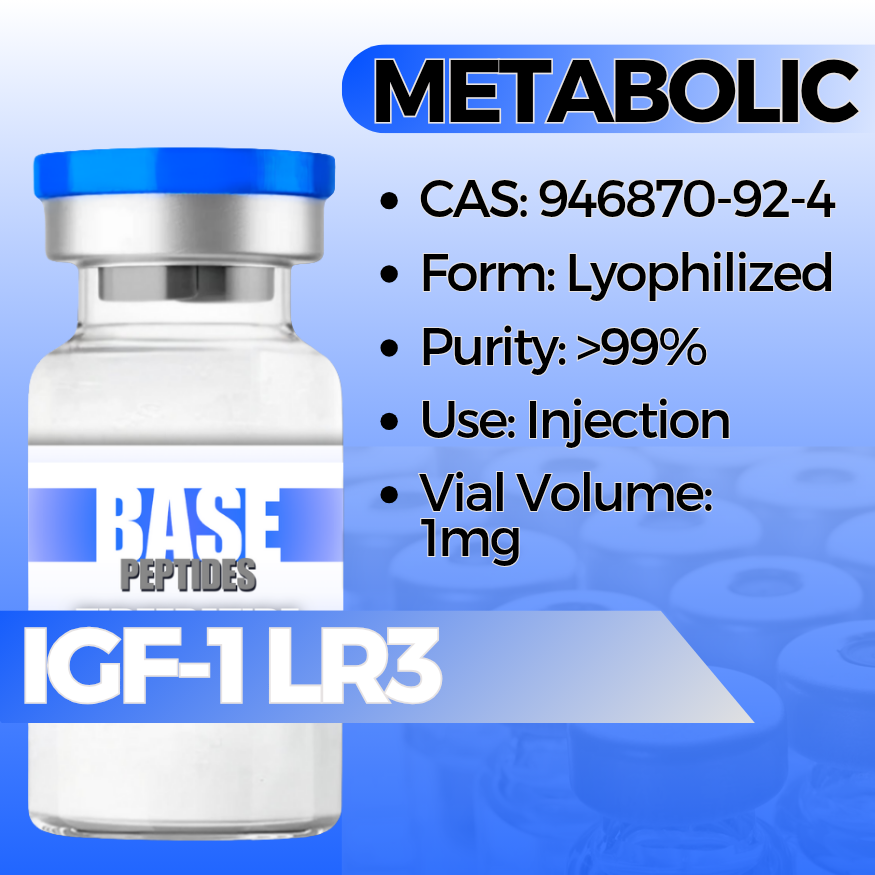
IGF-1 LR3 – Research Overview, Mechanism & Scientific Profile
What is IGF-1 LR3?
IGF-1 LR3 (Insulin-Like Growth Factor-1 Long R3) is a synthetic analog of IGF-1, a naturally occurring protein involved in growth, cell development, and tissue repair processes. It has been modified to extend its activity and stability in experimental settings, making it a subject of interest in biochemical and cellular research.
Compared to natural IGF-1, IGF-1 LR3 has structural changes that allow it to remain active for longer periods in laboratory models, which is why it is frequently used in controlled studies.
It is important to note that IGF-1 LR3 is considered a research-use compound and is not approved for general medical or consumer use in many regions.
Scientific Background of IGF-1 LR3
IGF-1 plays a key role in growth and development by mediating the effects of growth hormone (GH). IGF-1 LR3 was developed to study these pathways more effectively due to its enhanced properties.
Researchers study IGF-1 LR3 to explore:
- Cellular growth signaling pathways
- Protein synthesis mechanisms
- Tissue repair and regeneration models
- Hormonal signaling interactions
Its extended activity allows scientists to observe longer-term effects in experimental systems.
How IGF-1 LR3 Works (Mechanism of Action)
IGF-1 LR3 binds to the IGF-1 receptor (IGF-1R) on cells, activating signaling pathways that regulate growth and metabolic activity.
IGF-1R activation→Protein Synthesis↑→Cell Growth↑IGF\text{-}1R \ activation \rightarrow Protein\ Synthesis \uparrow \rightarrow Cell\ Growth \uparrow
Once activated, these pathways influence:
- Cellular proliferation
- Protein synthesis
- Nutrient uptake
- Tissue development signals
The modified structure of IGF-1 LR3 also reduces its binding to certain inhibitory proteins, which may increase its biological availability in research models.
Key Differences: IGF-1 vs IGF-1 LR3
Understanding the difference between natural IGF-1 and IGF-1 LR3 is important in research:
IGF-1 (Natural):
- Shorter half-life
- Regulated tightly by binding proteins
- Naturally produced in the body
IGF-1 LR3:
- Extended half-life in experimental models
- Reduced binding to inhibitory proteins
- Increased activity duration
Half-lifeLR3>Half-lifeIGF-1Half\text{-}life_{LR3} > Half\text{-}life_{IGF\text{-}1}
These differences make IGF-1 LR3 particularly useful in laboratory research where sustained signaling is needed.
Research Applications of IGF-1 LR3
IGF-1 LR3 is studied in multiple scientific fields:
1. Cellular Growth Research
Researchers examine how IGF-1 signaling affects cell division and development.
2. Muscle and Tissue Models
It is used to study protein synthesis and tissue regeneration in controlled experimental systems.
3. Endocrine System Studies
IGF1 LR3 helps researchers understand how growth hormone interacts with downstream signaling pathways.
4. Metabolic Research
It is explored for its role in glucose metabolism and nutrient utilization.
Why Researchers Study IGF-1 LR3
IGF1 LR3 provides a useful model for understanding complex biological systems, particularly:
- Growth factor signaling pathways
- Hormonal feedback loops
- Cellular adaptation and repair mechanisms
- Interaction between growth hormone and IGF systems
Its extended activity allows for more consistent observation in controlled environments.
Key Properties in Research Settings
IGF1 LR3 is of interest due to:
- Increased stability compared to natural IGF-1
- Prolonged activity in experimental conditions
- Strong receptor binding affinity
- Reduced interaction with binding proteins
These properties make it valuable for studying long-term cellular responses.
Safety and Regulatory Considerations
IGF 1 LR3 is classified as a research compound and is not approved for:
- Human consumption
- Medical treatment
- Dietary supplementation
Because of its potent biological activity, it is typically handled only in controlled laboratory environments.
Research into long-term effects in humans is limited, and regulatory status varies depending on jurisdiction.
Storage and Handling (Research Context)
To maintain stability and integrity:
- Store in a cool, dry environment
- Protect from light exposure
- Keep containers tightly sealed
- Follow laboratory handling protocols
Proper storage is essential to preserve activity and ensure reliable experimental outcomes.
Importance in Modern Research
IGF 1 LR3 contributes to ongoing scientific understanding of:
- Growth factor biology
- Cellular repair and regeneration
- Hormonal signaling networks
- Metabolic and anabolic pathways
Its role in growth-related pathways makes it a key compound in endocrine and cellular biology research.
Conclusion
IGF 1 LR3 is a modified analog of IGF-1 designed for extended activity in research settings. It is widely studied for its effects on cellular growth, protein synthesis, and metabolic pathways. While it offers valuable insights in laboratory environments, it remains strictly a research-use-only compound with limited data outside controlled studies.


Reviews
There are no reviews yet.