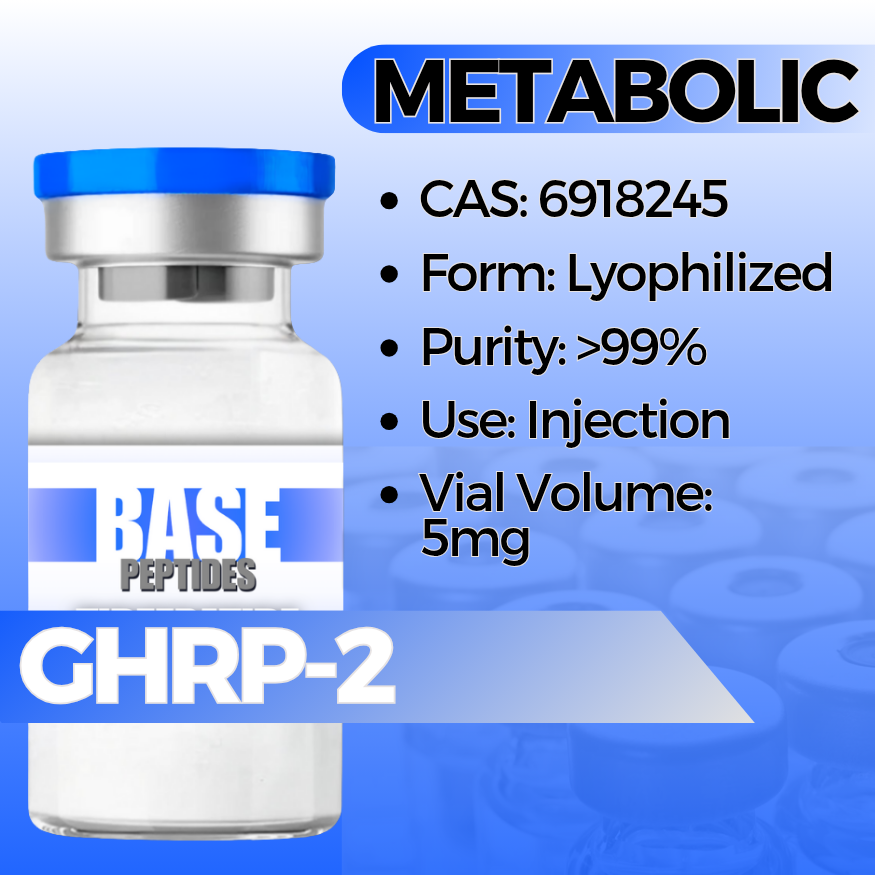
GHRP-2 – Research Overview, Mechanism & Scientific Profile
What is GHRP-2?
GHRP-2 (Growth Hormone Releasing Peptide-2) is a synthetic peptide studied in laboratory settings for its ability to stimulate the release of growth hormone (GH) through interaction with specific receptors. It belongs to a class of compounds known as growth hormone secretagogues, which are used in research to better understand endocrine signaling pathways.
GHRP-2 is commonly explored in controlled experimental environments due to its effects on hormone regulation and metabolic signaling. It is important to note that GHRP-2 is considered a research-use-only compound and is not approved for general medical or consumer use in many regions.
Scientific Background of GHRP-2
GHRP-2 was developed as part of research into growth hormone regulation and endocrine system function. It works by stimulating the ghrelin receptor (GHS-R1a), which plays a role in signaling the release of growth hormone from the pituitary gland.
Researchers study GHRP-2 to explore:
- Growth hormone secretion patterns
- Hormonal feedback mechanisms
- Appetite-related signaling pathways
- Metabolic regulation processes
Its activity in these systems makes it a useful tool in endocrine and biochemical research.
How GHRP-2 Works (Mechanism of Action)
GHRP-2 stimulates growth hormone release by binding to the ghrelin receptor, triggering a cascade of hormonal signals.
GHS-R1a activation→GH↑→IGF-1↑GHS\text{-}R1a \ activation \rightarrow GH \uparrow \rightarrow IGF\text{-}1 \uparrow
This pathway results in increased levels of growth hormone and downstream IGF-1 in experimental models.
In research settings, scientists observe how this activation affects:
- Hormone secretion cycles
- Metabolic activity
- Cellular growth signaling
- Appetite-related pathways
Key Research Applications of GHRP-2
GHRP-2 is studied across multiple scientific fields:
1. Endocrine Research
Researchers analyze how growth hormone release is regulated and how secretagogues influence hormone patterns.
2. Metabolic Studies
It is used to study how growth hormone affects metabolism and energy utilization.
3. Appetite and Ghrelin Pathway Research
GHRP-2 is relevant in studies examining hunger signaling and ghrelin-related mechanisms.
4. Hormonal Feedback Systems
Scientists use it to explore how the body balances hormone production through feedback loops.
GHRP 2 vs Other Growth Hormone Secretagogues
GHRP-2 is often compared to other peptides in the same category:
GHRP-2:
- Strong stimulation of growth hormone release
- Active ghrelin receptor interaction
- Used in endocrine signaling studies
Other GHRPs (e.g., GHRP-6, Ipamorelin):
- Different receptor affinities
- Varying effects on appetite and hormone release
- Distinct research profiles
Secretagogue potency↑⇒GH release↑Secretagogue\ potency \uparrow \Rightarrow GH\ release \uparrow
These comparisons help researchers understand differences in peptide behavior.
Key Properties in Research Settings
GHRP 2 is of interest due to:
- Potent growth hormone stimulation
- Interaction with ghrelin receptors
- Short-acting peptide profile
- Use in pulsatile hormone release studies
These characteristics make it valuable in controlled laboratory experiments.
Safety and Regulatory Considerations
GHRP 2 is classified as a research-use compound and is not approved for:
- Human consumption
- Medical treatment
- Dietary supplementation
Because of its biological activity, it should only be handled in controlled research environments.
Potential considerations in research include:
- Hormonal imbalance in experimental models
- Effects on appetite signaling
- Limited long-term safety data
Storage and Handling (Research Context)
To maintain peptide stability:
- Store in a cool, dry environment
- Protect from light exposure
- Keep containers tightly sealed
- Follow laboratory handling protocols
Proper storage ensures consistent results and compound integrity.
Why Researchers Study GHRP-2
GHRP 2 remains a valuable compound in scientific research because it helps explore:
- Growth hormone regulation
- Endocrine system dynamics
- Metabolic signaling pathways
- Ghrelin receptor activity
Its ability to stimulate hormone release makes it a useful model for studying complex biological systems.
Importance in Modern Research
GHRP 2 contributes to broader scientific understanding of:
- Hormone signaling networks
- Growth factor interactions
- Appetite and metabolic regulation
- Cellular growth pathways
It is part of a wider group of peptides used to investigate endocrine function.
Conclusion
GHRP 2 is a synthetic peptide studied for its role in stimulating growth hormone release through ghrelin receptor activation. While it provides valuable insights into endocrine and metabolic processes, it remains strictly a research-use-only compound.
Ongoing studies continue to explore its mechanisms and applications in controlled laboratory settings.

Reviews
There are no reviews yet.