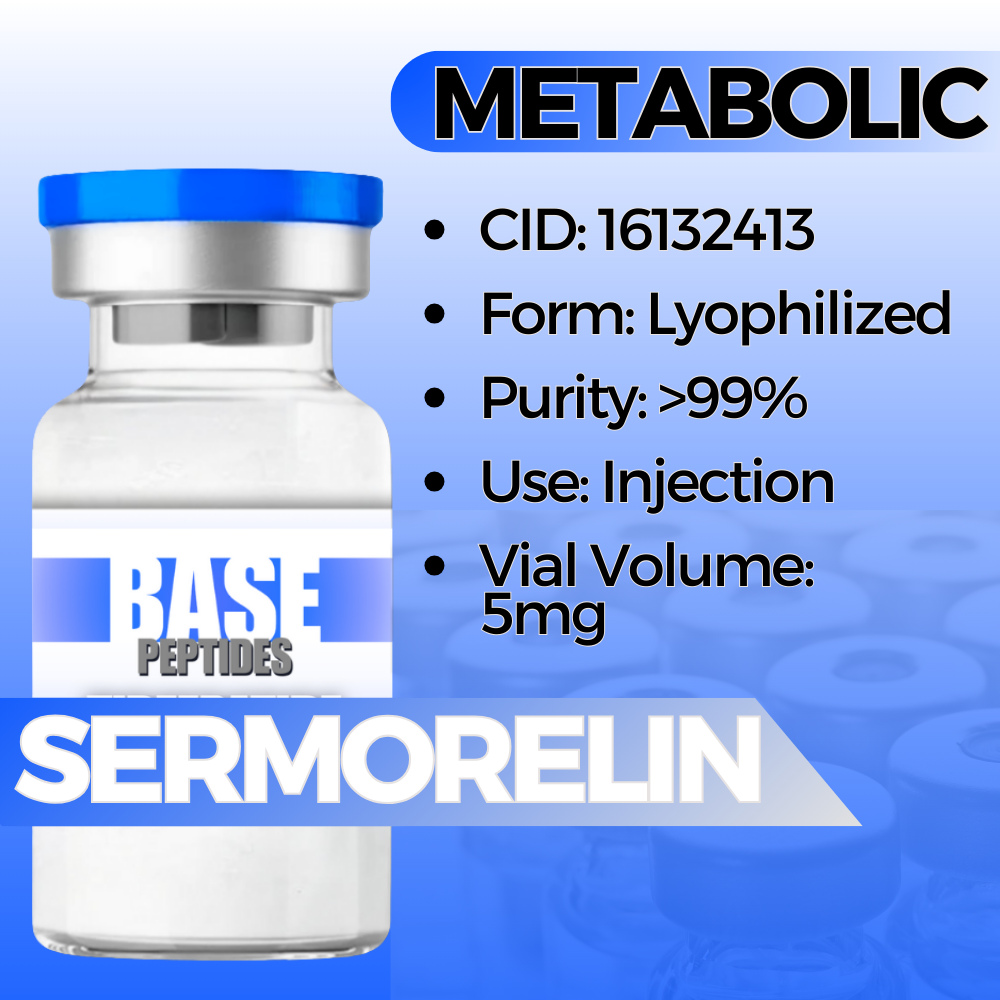
Sermorelin – Growth Hormone Releasing Hormone Analog Overview
Sermorelin is a synthetic peptide that has been studied in scientific and clinical research for its role as an analog of growth hormone-releasing hormone (GHRH). It is composed of a shortened amino acid sequence derived from the endogenous GHRH structure and is used in research settings to investigate pituitary signaling and growth hormone regulation pathways.
In biological systems, Sermorelin interacts with the anterior pituitary gland and is studied for its ability to stimulate natural growth hormone release through receptor-mediated mechanisms. Because of its defined structure and predictable receptor activity, it is widely used in endocrine and molecular biology research.
What is Sermorelin?
Sermorelin is a synthetic peptide fragment that corresponds to the first 29 amino acids of the naturally occurring growth hormone-releasing hormone. This region is responsible for activating GHRH receptors in the pituitary gland.
In research environments, Sermorelin is studied for its ability to:
- Activate GHRH receptors
- Stimulate growth hormone secretion pathways
- Model hypothalamic-pituitary signaling
- Analyze endocrine feedback loops
Because it mimics a natural regulatory hormone, it is frequently used in controlled laboratory studies focused on endocrine system function.
Mechanism of Action (Research Context)
Sermorelin works by binding to growth hormone-releasing hormone receptors located on pituitary somatotroph cells. This interaction triggers intracellular signaling cascades that lead to the release of growth hormone.
In laboratory research, Sermorelin is used to study:
- GHRH receptor activation pathways
- Cyclic AMP (cAMP) signaling mechanisms
- Growth hormone secretion dynamics
- Pituitary response regulation
Its mechanism provides a controlled model for studying natural growth hormone regulation processes.
Scientific Applications
Sermorelin is widely used in endocrine and biomedical research. Common applications include:
- Growth hormone regulation studies
- Pituitary gland function research
- Endocrine feedback loop analysis
- Age-related hormonal signaling models
- Receptor-ligand interaction studies
Researchers use Sermorelin as a tool to better understand how the body naturally regulates growth hormone production.
Sermorelin in Endocrine Research
One of the key uses of Sermorelin in scientific studies is modeling hypothalamic-pituitary axis function. This system plays a central role in hormone regulation and homeostasis.
Research areas include:
- Hypothalamic signaling pathways
- Pituitary hormone secretion mechanisms
- Growth hormone feedback regulation
- Endocrine system integration models
Sermorelin is particularly useful because it acts upstream in the hormonal signaling cascade.
Biological and Structural Characteristics
Sermorelin is a peptide composed of 29 amino acids. Its structure is designed to mimic the active region of endogenous GHRH while maintaining stability in laboratory conditions.
Key structural features include:
- Short peptide chain (29 amino acids)
- GHRH analog structure
- High receptor specificity
- Stability in controlled research environments
These characteristics make it a reliable compound for experimental endocrine studies.
Research Importance
It’s important in scientific research because it provides a controlled way to study natural growth hormone regulation. Instead of directly acting on growth hormone receptors, it works upstream, allowing researchers to observe physiological signaling processes more accurately.
Key research benefits include:
- Studying natural hormone release pathways
- Evaluating pituitary response behavior
- Modeling endocrine feedback systems
- Investigating receptor sensitivity
This makes Sermorelin a valuable tool in both basic and applied biomedical research.
Comparative Research Context
In peptide research, it’s often compared with other growth hormone-related compounds. However, its unique feature is its upstream action at the GHRH receptor level.
Researchers often analyze:
- Sermorelin vs direct GH secretagogues
- Receptor activation differences
- Signal pathway efficiency
- Duration and intensity of response
These comparisons help clarify how different hormonal pathways interact in biological systems.
Storage and Handling (Research Context)
In laboratory environments, it’s handled under strict conditions to preserve its stability and activity:
- Stored in cool, dry environments
- Protected from heat and light exposure
- Prepared using sterile laboratory procedures
- Used within validated experimental timelines
Proper handling ensures consistency and accuracy in research results.
Important Research Disclaimer
It’s intended strictly for laboratory and scientific research use only. It is not approved for human consumption, medical treatment, or diagnostic use. All research must comply with applicable institutional guidelines and local regulations.
Conclusion
It’s a synthetic peptide analog of growth hormone-releasing hormone that plays an important role in endocrine research. By acting on GHRH receptors in the pituitary gland, it allows researchers to study natural growth hormone regulation pathways in a controlled experimental setting.
Its value lies in its ability to model physiological hormone signaling, making it a key tool in studies of endocrine function, receptor activity, and hormonal feedback systems.
Reviews
There are no reviews yet.