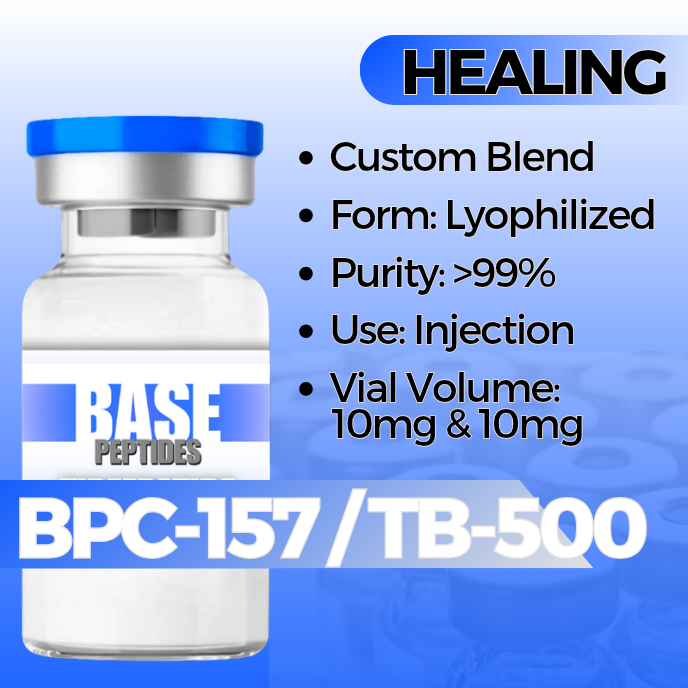
BPC-157 + TB-500 Blend (10mg-10mg) – Peptide Combination Research Overview
The combination of BPC-157 + TB-500 Blend (10mg-10mg) represents a dual-peptide formulation studied in laboratory research for its interaction with cellular signaling pathways, tissue response mechanisms, and molecular communication systems. Both peptides are widely examined individually in experimental biology, and their combined use is explored in research models to better understand how multiple peptide signals may influence biological processes.
In scientific contexts, this blend is investigated for its potential to interact with pathways related to cellular migration, structural integrity, and signaling coordination. The combination approach allows researchers to study how different peptide mechanisms may complement each other within controlled environments.
What is BPC-157 + TB-500 Blend (10mg-10mg)?
BPC-157 + TB-500 Blend (10mg-10mg) is a synthetic pentadecapeptide derived from a gastric protein, while TB-500 is a synthetic peptide fragment of thymosin beta-4, a naturally occurring protein involved in cellular structure and movement.
When studied together in research settings, this combination is used to explore:
- Cellular signaling interactions
- Peptide synergy in biological systems
- Tissue response modeling
- Molecular communication pathways
The blend is not a single molecule but rather a combination of two distinct peptides with different but potentially complementary mechanisms.
BPC-157 Research Profile
BPC-157 is widely studied in laboratory environments for its interaction with cellular signaling systems. Research focuses on its involvement in:
- Growth factor signaling pathways
- Nitric oxide system interactions
- Cellular communication and migration
- Gene expression responses
Its stability in experimental conditions makes it a frequently used peptide in molecular and physiological research.
TB-500 Research Profile
TB-500 is a synthetic version of a region of thymosin beta-4, a protein associated with cellular movement and structural organization.
In research models, TB-500 is studied for:
- Cell migration processes
- Cytoskeletal organization
- Protein interaction pathways
- Tissue structure and signaling mechanisms
Its role in actin-binding and cellular structure studies makes it relevant in experimental biology.
Combined Mechanism (Research Context)
When used together in laboratory studies, BPC-157 and TB-500 are examined for their combined influence on cellular systems. Researchers explore how the peptides may interact across multiple pathways, including:
- Signaling pathway coordination
- Cellular communication networks
- Intracellular response mechanisms
- Structural and functional cell dynamics
The combination is used to observe how multiple peptide signals can operate simultaneously within biological systems.
Scientific Applications
The BPC-157 + TB-500 Blend (10mg-10mg) is used in experimental research across several fields, including molecular biology, physiology, and biochemistry.
Common applications include:
- Cellular signaling pathway studies
- Tissue response modeling
- Protein interaction analysis
- Experimental physiology research
- Multi-peptide interaction studies
These applications help researchers understand how different peptides influence biological systems when combined.
Cellular and Molecular Research Use
One of the key areas of interest for this peptide combination is its effect on cellular communication and structure.
Researchers investigate:
- Cell-to-cell signaling interactions
- Cytoskeletal dynamics
- Intracellular communication pathways
- Cellular adaptation to experimental conditions
Studying both peptides together provides insight into how different signaling mechanisms may work in parallel.
Comparative and Synergy Research
In peptide science, combination studies are often conducted to evaluate whether two compounds produce additive or complementary effects.
With BPC-157 and TB-500, researchers analyze:
- Differences between individual vs combined peptide activity
- Overlapping signaling pathways
- Complementary biological mechanisms
- Efficiency of multi-pathway interaction models
These studies are important for understanding complex biological systems where multiple signals operate simultaneously.
Structural Characteristics
The blend consists of two distinct peptide structures:
- BPC-157: 15 amino acids (pentadecapeptide)
- TB-500: Active fragment of thymosin beta-4
Key characteristics include:
- Stability in controlled laboratory conditions
- Interaction with multiple signaling pathways
- Suitability for experimental research models
- Use in combination-based peptide studies
Importance in Scientific Research
This peptide combination is valuable because it allows researchers to study multi-pathway biological interactions in a controlled setting.
Key research benefits include:
- Understanding complex signaling systems
- Studying peptide synergy
- Exploring cellular communication networks
- Investigating molecular response coordination
These insights contribute to broader knowledge in peptide science and molecular biology.
Storage and Handling (Research Context)
In laboratory environments, peptide blends are handled under strict conditions to maintain stability:
- Stored in low-temperature environments
- Protected from light and moisture
- Prepared using sterile laboratory techniques
- Used within validated research protocols
Proper handling ensures reproducible and accurate experimental results.
Important Research Disclaimer
BPC-157 + TB-500 Blend (10mg-10mg) are intended strictly for laboratory and scientific research use only. They are not approved for human consumption, medical treatment, or diagnostic use. All research must comply with applicable regulations and institutional guidelines.
Conclusion
The BPC-157 + TB-500 Blend (10mg-10mg) blend represents a combination of two well-studied peptides used in molecular and cellular research. By examining their interactions, researchers can gain insight into how multiple signaling pathways operate together within biological systems.
Ongoing research continues to explore the effects of peptide combinations, contributing to a deeper understanding of cellular communication and molecular biology.


Reviews
There are no reviews yet.