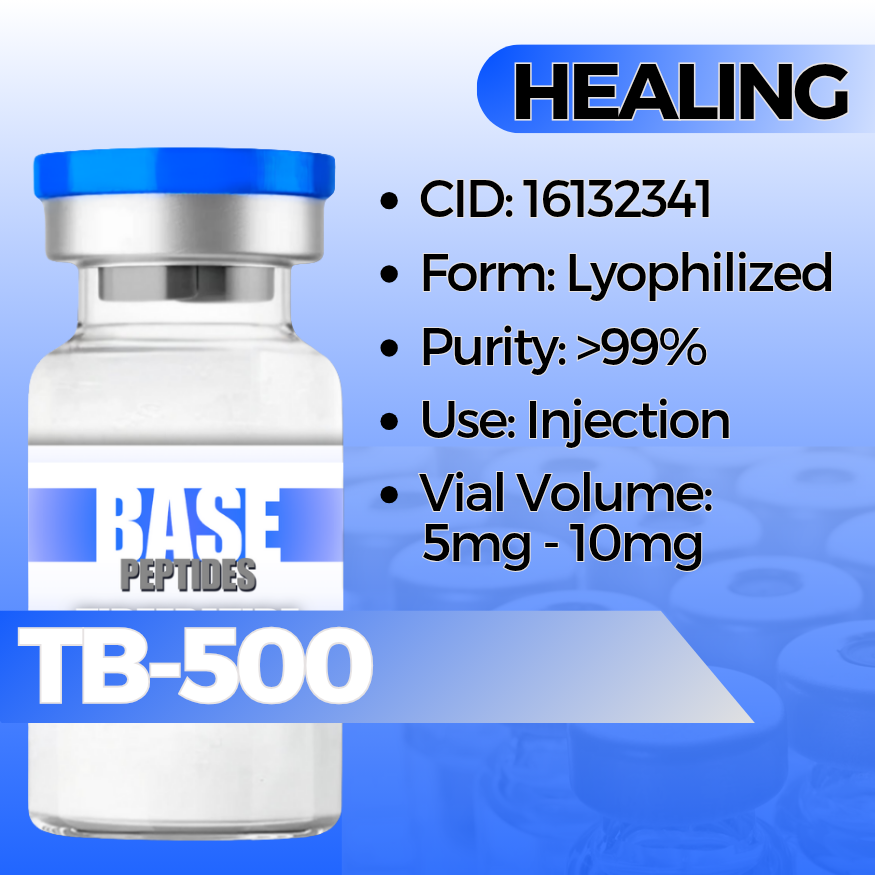
TB-500 (Thymosin Beta-4 Fragment) – Cellular Migration & Peptide Research Overview
TB-500 is a synthetic peptide fragment derived from thymosin beta-4, a naturally occurring protein involved in cellular structure, movement, and tissue organization. In laboratory and molecular biology research, TB-500 is widely studied for its role in cytoskeletal dynamics, cell migration, and signaling pathways related to cellular response and structural adaptation.
In scientific contexts, TB-500 is used as a research tool to investigate how cells coordinate movement, repair processes, and communication within complex biological systems.
What is TB-500?
TB-500 is a synthetic peptide modeled after a specific active region of thymosin beta-4, a protein found in nearly all human and animal cells. Thymosin beta-4 plays a role in actin regulation, which is essential for maintaining cell structure and enabling movement.
In research environments, TB-500 is studied for its involvement in:
- Cellular migration mechanisms
- Cytoskeletal organization
- Protein interaction networks
- Tissue response modeling
- Cellular communication pathways
Its simplified peptide structure allows researchers to isolate specific biological functions of thymosin beta-4.
Role in Cellular Structure and Movement
One of the primary research focuses of TB-500 is its relationship with the actin cytoskeleton, a network of proteins responsible for maintaining cell shape and enabling movement.
Research areas include:
- Actin polymerization and depolymerization
- Cellular motility and migration models
- Structural integrity of cells
- Intracellular transport mechanisms
These studies help scientists understand how cells move, adapt, and reorganize in response to environmental changes.
Mechanism of Action (Research Context)
In laboratory research, TB-500 is investigated for its influence on cellular signaling pathways and structural proteins. While its full mechanism is still under study, it is believed to interact with:
- Actin-binding protein systems
- Cytoskeletal regulation pathways
- Cell migration signaling networks
- Intracellular communication processes
Researchers use TB-500 to explore how cells coordinate structural changes and movement at a molecular level.
Scientific Applications
TB-500 is widely used in experimental research across molecular biology, cell biology, and biochemistry.
Common applications include:
- Cell migration and motility studies
- Cytoskeletal dynamics research
- Tissue response modeling in vitro
- Protein interaction analysis
- Cellular signaling pathway investigation
These applications provide insight into how biological systems regulate structure and movement.
Cell Migration and Tissue Response Research
A major area of interest for TB-500 is its role in cell migration research. Cell migration is essential for many biological processes, including development, immune response, and tissue organization.
Research focuses include:
- Directional cell movement (chemotaxis models)
- Tissue organization and remodeling
- Cellular response to environmental signals
- Coordination of multi-cellular systems
These studies help researchers understand how cells move and organize within biological structures.
Cytoskeletal Dynamics
TB-500 is strongly associated with actin cytoskeleton regulation, making it important in structural biology research.
Researchers investigate:
- Actin filament formation and breakdown
- Cell shape regulation mechanisms
- Structural protein interactions
- Intracellular scaffolding systems
This research contributes to understanding how cells maintain structure while remaining flexible and mobile.
Protein Interaction and Signaling Research
TB-500 is also studied for its involvement in protein interaction networks that regulate cellular behavior.
Key research areas include:
- Protein binding and signaling pathways
- Intracellular communication systems
- Regulation of structural proteins
- Coordination of cellular responses
These studies help map complex biological interactions at the molecular level.
Structural Characteristics
TB-500 is a synthetic peptide fragment derived from thymosin beta-4.
Key characteristics include:
- Derived from a naturally occurring protein
- Short peptide sequence
- High solubility in laboratory environments
- Ability to interact with actin-related systems
Its structure allows for targeted experimental use in cell biology research.
Importance in Scientific Research
TB-500 is important in research because it provides a model for studying cell movement, structure, and communication.
Key research benefits include:
- Understanding cytoskeletal regulation
- Studying cellular migration mechanisms
- Exploring protein interaction networks
- Investigating structural adaptation processes
These insights contribute to advancements in cell biology and molecular research.
Comparative Research Context
In peptide research, TB-500 is often compared with full-length thymosin beta-4 and other cytoskeletal regulatory proteins.
Researchers analyze:
- Differences between fragment and full protein activity
- Efficiency of actin regulation pathways
- Stability and cellular interaction profiles
- Effects on migration and structural models
These comparisons help refine understanding of cytoskeletal biology.
Storage and Handling (Research Context)
In laboratory environments, TB-500 is handled under controlled conditions to ensure stability and accuracy:
- Stored in low-temperature environments
- Protected from light and moisture
- Prepared using sterile laboratory techniques
- Used within validated research protocols
Proper handling ensures reproducible experimental results.
Important Research Disclaimer
TB-500 is intended strictly for laboratory and scientific research use only. It is not approved for human consumption, medical treatment, or diagnostic use. All research must comply with applicable institutional guidelines and local regulations.
Conclusion
TB 500 is a synthetic peptide fragment derived from thymosin beta-4, widely studied for its role in cellular migration, cytoskeletal regulation, and structural protein interactions. Its involvement in cell movement and organization makes it a valuable tool in molecular and cell biology research.
Ongoing studies continue to explore its effects on cellular structure and signaling systems, contributing to a deeper understanding of biological organization and function.


Reviews
There are no reviews yet.