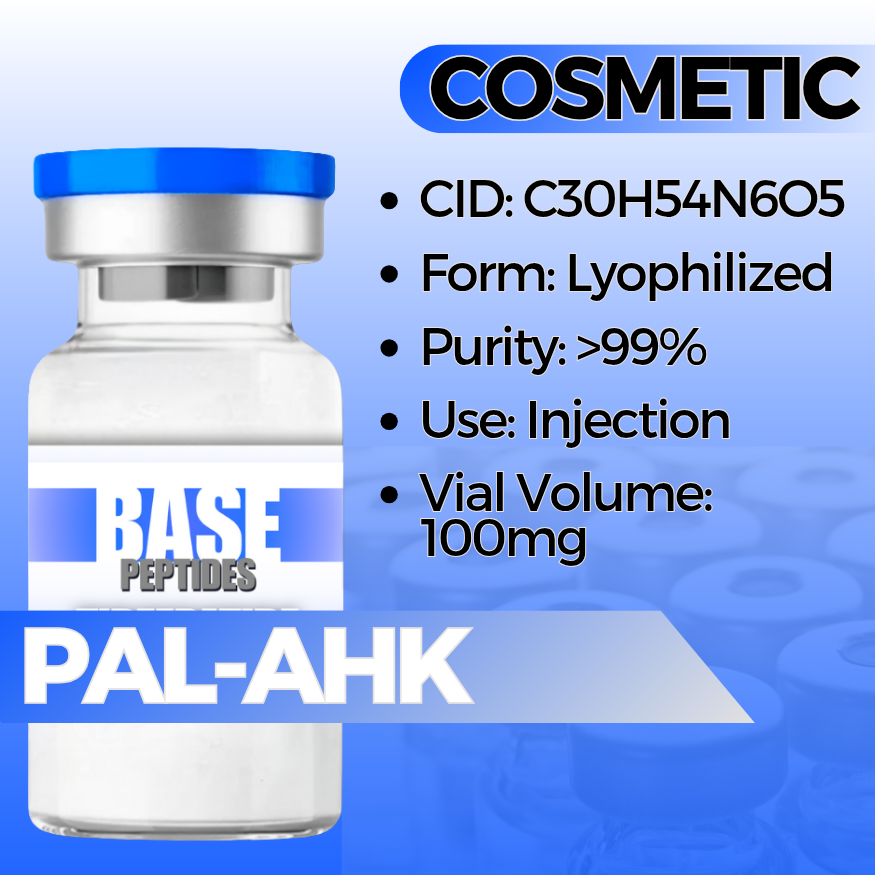
PAL-AHK – Peptide Overview, Mechanism & Skin Biology Research Guide
What is PAL-AHK?
PAL-AHK is a synthetic peptide fragment commonly studied in cosmetic and biochemical research. It is derived from a tripeptide sequence associated with skin biology and is often modified with a palmitoyl (PAL) group, which helps improve stability and skin penetration in topical formulations.
In skincare science, PAL-AHK is explored for its potential role in supporting skin appearance, structure, and biological signaling pathways. It is typically used in research or cosmetic-grade formulations rather than as a standalone medical compound.
Structure and Composition
PAL-AHK consists of two main parts:
- AHK peptide sequence (Alanine–Histidine–Lysine)
- Palmitoyl group (fatty acid chain) to enhance lipophilicity
The addition of the palmitoyl group helps the peptide interact more effectively with the skin’s lipid barrier, improving stability and absorption in topical applications.
Peptide modification↑→Skin penetration↑→Bioavailability↑Peptide\ modification \uparrow \rightarrow Skin\ penetration \uparrow \rightarrow Bioavailability \uparrow
How PAL-AHK Works in Skin Research
PAL-AHK is studied for its interaction with cell signaling pathways involved in skin maintenance and repair. While research is ongoing, it is generally associated with:
- Skin cell communication
- Structural protein regulation
- Barrier function support
- Cosmetic skin conditioning effects
It is primarily used in in-vitro and cosmetic formulation research, not as a therapeutic drug.
Key Areas of Research Interest
PAL-AHK is commonly explored in dermatological and cosmetic science for:
1. Skin Appearance Studies
Researchers examine how peptides influence visible skin texture and smoothness.
2. Barrier Function Research
Studies investigate how peptide-based formulations support the skin’s protective barrier.
3. Cellular Signaling
PAL-AHK is analyzed for its role in peptide-based communication between skin cells.
4. Cosmetic Formulation Science
Used in experimental skincare products to evaluate stability and delivery systems.
Biological Role of AHK Peptides
The AHK peptide sequence is part of a broader category of bioactive peptides that interact with skin-related biological processes.
Bioactive peptides→Cellular signaling↑→Skin structure supportBioactive\ peptides \rightarrow Cellular\ signaling \uparrow \rightarrow Skin\ structure\ support
These peptides are studied for their potential role in:
- Cellular communication
- Protein expression regulation
- Skin maintenance processes
Why Palmitoylation Matters
The “PAL” (palmitoyl) modification is important because it:
- Improves peptide stability
- Enhances skin absorption potential
- Increases lipid affinity
- Extends activity in topical formulations
This modification is widely used in cosmetic peptide technology to improve performance in skincare applications.
Applications in Cosmetic Science
PAL-AHK is mainly used in:
1. Anti-Aging Skincare Research
Studied for its role in supporting skin texture and appearance.
2. Peptide Formulation Development
Used to test how peptides behave in creams, serums, and emulsions.
3. Skin Conditioning Products
Included in experimental cosmetic formulations aimed at improving skin feel and hydration.
4. Barrier Support Studies
Evaluated for its interaction with the outer skin layer (stratum corneum).
How PAL-AHK Fits Into Peptide Skincare
Peptides like PAL-AHK are part of a growing category of cosmetic bioactive ingredients designed to interact with skin at a molecular level.
Peptide skincare→Molecular interaction↑→Skin support↑Peptide\ skincare \rightarrow Molecular\ interaction \uparrow \rightarrow Skin\ support \uparrow
This approach focuses on supporting skin biology rather than only providing surface hydration.
Formulation Types
PAL-AHK is typically found in:
- Serums
- Creams
- Emulsion-based skincare products
- Experimental cosmetic formulations
It is usually combined with:
- Hydrating agents (e.g., hyaluronic acid)
- Antioxidants
- Other peptides for synergistic effects
Safety and Usage Considerations
PAL-AHK is generally considered a cosmetic or research ingredient, and key considerations include:
- Use only in properly formulated skincare products
- Avoid direct raw compound handling without formulation expertise
- Perform patch testing for topical products
- Discontinue use if irritation occurs
As with many peptides, effects depend heavily on formulation quality and concentration.
Why PAL-AHK Is Used in Modern Skincare Research
Interest in PAL-AHK comes from the broader trend of peptide-based skincare innovation, which focuses on:
- Skin communication pathways
- Structural protein support
- Barrier health optimization
- Advanced cosmetic delivery systems
This aligns with the shift toward science-driven cosmetic formulations.
Conclusion
PAL-AHK is a palmitoylated bioactive peptide studied in cosmetic and dermatological research for its potential role in skin signaling, barrier support, and formulation science. While not a medical compound, it plays an important role in the development of advanced peptide-based skincare products.
Its value lies in helping researchers and formulators explore how peptides interact with skin biology and cosmetic delivery systems.

Reviews
There are no reviews yet.